Skip to content

Journal “Cultural Anthropology” goes open access

Journal “Cultural Anthropology” goes open access published on No Comments on Journal “Cultural Anthropology” goes open access

The Society for Cultural Anthropology, in March 2013, announced plans for Cultural Anthropology to become an open access journal. Starting with its February 2014 issue (volume 29, number 1), new issues of the journal became freely available online through the CA website, and plans are in the works to make back issues available as well.

more info at: http://www.culanth.org/articles/open_access
first open access issue: http://www.culanth.org/issues/162-29-1-february-2014

Notes: Open access & anthropology

Notes: Open access & anthropology published on No Comments on Notes: Open access & anthropology

Open Access (OA): freier Zugang zu wiss. Material
Goldener / Grüner Weg
alternatives Publikations- & Geschäftsmodell
2017-2021: ~50% OA Publikationen (Lewis 2012) http://crl.acrl.org/content/73/5/493

AutorInnen: + Verbreitung
LeserInnen: + Zugang
Bibliotheken: + Ersparnis
Gesellschaft: + Einsicht/Verständnis
http://de.wikipedia.org/wiki/Open_access
http://www.youtube.com/watch?v=L5rVH1KGBCY
http://www.doaj.org/
http://www.fwf.ac.at/de/public_Relations/oai/

HAU-Journal of Ethnographic Theory (seit 2011)
international, peer-reviewed, open-access (CC-Lizenz), online
ethnography as the prime heuristic & in the forefront of anthropology
http://www.haujournal.org

HAU-N.E.T., Network of Ethnographic Theory
international network of research centres & anthropology departments to support journal HAU
alternative to existing subscription models in publishing
http://www.haujournal.org/haunet/

Paper: Von „Cyber Anthropologie“ zu „Digitaler Anthropologie“: kultur- und sozialanthropologische Beiträge zur Erforschung digitaler Medientechnologien.

Paper: Von „Cyber Anthropologie“ zu „Digitaler Anthropologie“: kultur- und sozialanthropologische Beiträge zur Erforschung digitaler Medientechnologien. published on No Comments on Paper: Von „Cyber Anthropologie“ zu „Digitaler Anthropologie“: kultur- und sozialanthropologische Beiträge zur Erforschung digitaler Medientechnologien.

Budka. P. 2014. Von „Cyber Anthropologie“ zu „Digitaler Anthropologie“: kultur- und sozialanthropologische Beiträge zur Erforschung digitaler Medientechnologien. Vortrag im Rahmen der Ringvorlesung: „Rituale, Medien, Bewusstsein – in Memoriam Manfred Kremser“, 9. Januar 2014.

Einleitung

Dieser Vortrag wirft einen Blick auf die kultur- und sozialanthropologische Erforschung digitaler Medientechnologien wie Internet, Soziale Online-Netzwerke und mobile Kommunikationstechnologien. Dabei werden die Grundzüge des Forschungsfeldes der „Cyber Anthropologie“ – besonders im Bezug zum Wiener Institut für Kultur- und Sozialanthropologie – ebenso vorgestellt wie die rezente Entwicklung einer „Digitalen Anthropologie“. Die gemeinsame, übergeordnete Frage dieser kultur- und sozialanthropologischen Projekte lautet: „Was bedeutet Menschsein in einer (zunehmend) digitalen Welt?“. Fallbeispiele aus der ethnographischen Forschungspraxis behandeln konkrete Aspekte des „digitalen Menschseins“ und runden die theoretische Diskussion ab.

Medienanthropologie und die technische Mediatisierung von Kommunikation

In der Kultur- und Sozialanthropologie lässt sich die Forschung zu Medientechnologien grundsätzlich als Forschung zu menschlicher Kommunikation, die von Technologien mediatisiert wird, verstehen. Diese Mediatisierung von Kommunikation ist für die Kultur- und Sozialanthropologie besonders hinsichtlich ihrer Einbettung in soziokulturelle und historische Prozesse und Kontexte interessant: „The key questions for the anthropologist are how these technologies operate to mediate human communication, and how such mediation is embedded in broader social and historical processes“ (Peterson 2003: 5).

In der Medienanthropologie geht es um die Mediatisierung von Kommunikation in unterschiedlichen soziokulturellen Kontexten und unter spezifischen historischen, politischen und ökonomischen Bedingungen.

In der Kultur- und Sozialanthropologie werden Medien nicht auf ihre Inhalte oder Botschaften reduziert. Im Versuch ein möglichst ganzheitliches Bild von Medienphänomenen zu erlangen, werden Kontexte und Bedingungen unter denen Medien produziert, verteilt und genutzt werden ebenso analysiert wie die technischen Aspekte von Medien. Medien beinhalten immer auch Technologien, die die Mediatisierung von Kommunikation erst ermöglichen. Es macht also Sinn nicht nur von Medien sondern von Medientechnologien zu sprechen.

Über Medientechnologien entwickeln Menschen neue Beziehungen zu Zeit und Raum sowie zu Körper und Wahrnehmung. Und diese Verhältnisse verändern sich aufgrund medientechnologischer Entwicklungen permanent. Die „greifbare“ Materialität von Medientechnologien und die damit verbundenen phänomenologischen Erfahrungen sind also wesentlicher Gegenstand medienethnographischer und medienanthropologischer Forschung (vgl. Ginsburg et al. 2002: 21).

Wichtigste methodische Herangehensweise, um Medienphänomene zu erfassen, ist für die Medienanthropologie, wie für die Kultur- und Sozialanthropologie im Allgemeinen, die ethnographische Feldforschung. Diese methodische Strategie zur empirischen Datenerhebung passt sich dabei sowohl dem Feld als auch den soziokulturellen Handlungsräumen der Menschen an (vgl. z.B. Kremser 1998, Marcus 1998) und kann sich also nicht allein auf Inhalte und deren Rezeption beschränken. Sie muss auch die physischen und sensorischen Dimensionen von Medientechnologien miteinbeziehen, weil über diese soziale Beziehungen hergestellt werden können.

Technologie im soziokulturellen Kontext

Seit den 1950er Jahren untersuchen Kultur- und SozialanthropologInnen neue und „moderne“ Technologien und wie diese vor allem in „nicht-westlichen“ Gemeinschaften verwendet und angeeignet werden (vgl. z.B. Beck 2001, Godelier 1971, Pfaffenberger 1992, Sharp 1952). Doch wie unter anderem Arturo Escobar (1994) meint, ist es schwierig diese Forschungsansätze und -befunde auf hochkomplexe technische Umgebungen in „modernen“ Gesellschaften zu übertragen. Aus kultur- und sozialanthropologischer Perspektive bedeutet diese Transferschwierigkeit weder eine Hierarchisierung von soziotechnischen Systemen und damit verbunden von Gesellschaften, noch bedeutet dies eine Abwertung „nicht-moderner“ oder „traditioneller“ soziotechnischer Systeme. All diese Systeme – vom Töpfern in Indien bis zum Programmieren von Software in Kalifornien – sind hochkomplex und heterogen.

Es besteht allerdings dringender Bedarf an theoretischen Zugängen und weiteren empirischen Befunden, die zum Verständnis soziotechnischer Systeme in „modernen“ Gesellschaften beitragen. So befasst sich auch die Kultur- und Sozialanthropologie zunehmend mit soziotechnischen Systemen in zeitgenössischen Gesellschaften (vgl. z.B. Rabinow 2008, Rabinow & Marcus 2008) – vor allem auch, weil immer wieder Fragen auftauchen, die scheinbar nur von der Kultur- und Sozialanthropologie beantwortet werden können, etwa nach der soziokulturellen und soziokulturell unterschiedlichen Bedeutung von Technologien (vgl. Pfaffenberger 1988, 1992).

Die Kultur- und Sozialanthropologie versucht zu verstehen, wie Technologie – beispielsweise in Form materieller Kultur oder als soziotechnisches System – (kulturell) konstruiert und (sozial) verwendet, genutzt und angeeignet wird. Ähnliche Ziele verfolgen auch Wissenschaftsforschung, Science and Technology Studies und sozialwissenschaftliche Technikforschung (vgl. z.B. Eglash 2006). Die Entwicklung und der Aufschwung digitaler (Medien)Technologien führen zu einer weiteren Differenzierung dieses Forschungsbereichs und zur Etablierung neuer Schwerpunkte.

Text (PDF)
Paper: Football fan communities and identity construction

Paper: Football fan communities and identity construction published on No Comments on Paper: Football fan communities and identity construction

Budka, P., Jacono, D. 2013. Football fan communities and identity construction: Past and present of “Ultras Rapid” as sociocultural phenomenon. Paper at “Kick It! The Anthropology of European Football” Conference, 25-26 October 2013.

Introduction

Eduardo Archetti (1992: 232) argues that “football is neither a ritual of open rebellion nor the much mentioned opium of the masses. It is a rich, complex, open scenario that has to be taken seriously”. Archetti’s argument is in line with the most recent research in fan and football fan culture (e.g. Giulianotti & Armstrong 1997, Gray, Sandvoss & Harrington 2007). Because to study fans and fandom means ultimately to study how culture and society works.

In this paper we are going to discuss, within the framework of an anthropology of football, selected aspects of a special category of football fans: the ultras. By analysing the history and some of the sociocultural practices of the largest Austrian ultra group – “Ultras Rapid Block West 1988” – the paper aims to show how individual and collective fan identities are created in everyday life of football fan culture.

“Ultras no fans!” is a slogan that is being found among ultra groups across Europe. Despite this clear “emic” statement of differentiation between “normal” football fans and “ultras”, ultras are, at least from a research perspective, basically fans. So we begin our examinations in the phenomenon of “Ultras Rapid” by briefly discussing anthropological and ethnographic research in football and football fans. We then set forth to present selected characteristics of SK Rapid Wien’s largest ultra group that is also the oldest still active ultra movement in the German-speaking countries.

The authors themselves are fans of SK Rapid Wien and have been following the club and its fan culture for several decades (e.g. Jacono 2014). Building on ethnographic fieldwork, including participant observation, historical and archival studies, this paper intends to contribute to the anthropological and ethnographic understanding of the sociocultural phenomenon of football fan culture.

Text (PDF)

Digital learning material for social & cultural anthropology

Digital learning material for social & cultural anthropology published on No Comments on Digital learning material for social & cultural anthropology

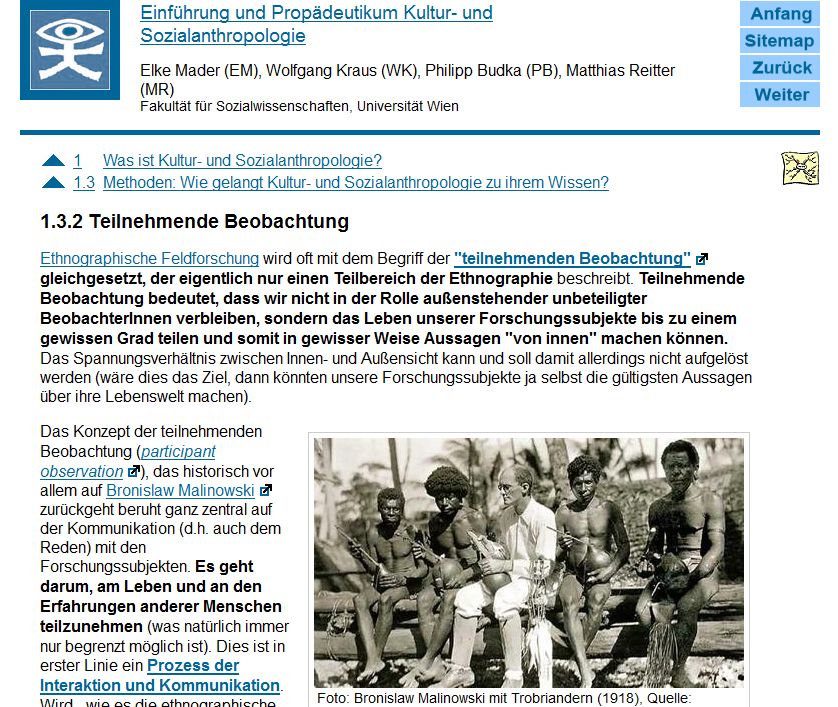
Within a project different digital learning materials for the social sciences, particularly at the University of Vienna, were developed. This is a hypermedia learning and teaching document for introductory courses in social and cultural anthropology (in German).

screenshot of digital learning document

“Diese Lernunterlage gibt einen einführenden Überblick zur wissenschaftlichen Disziplin der Kultur- und Sozialanthropologie (KSA) mit besonderem Schwerpunkt auf die Situation und die Arbeit des Instituts für Kultur- und Sozialanthropologie an der Universität Wien. Neben der Frage, womit sich Kultur- und Sozialanthropologie beschäftigt und wie sie sich theoriegeschichtlich entwickelt hat, werden ausgewählte Themenbereiche vorgestellt. Die Lernunterlage richtet sich vor allem an StudienanfängerInnen, kann aber ebenso als Informationsquelle oder Lehr- und Lernmittel für allgemein an der Kultur- und Sozialanthropologie Interessierte dienen.”

Link:

http://www.univie.ac.at/sowi-online/esowi/cp/einfpropaedksa/einfpropaedksa-titel.html


Article: Digitale Medientechnologien aus kultur- und sozialanthropologischer Perspektive

Article: Digitale Medientechnologien aus kultur- und sozialanthropologischer Perspektive published on 1 Comment on Article: Digitale Medientechnologien aus kultur- und sozialanthropologischer Perspektive

Budka, P. 2013. Digitale Medientechnologien aus kultur- und sozialanthropologischer Perspektive: Überlegungen zu Technologie als materielle Kultur und Fetisch (Digital media technologies from an anthropological perspective: Reflections on technology as material culture and fetish). Medien und Zeit, 28, 1/2013: 22-34.

Abstract

Dieser Aufsatz blickt auf digitale Medientechnologien aus Perspektive der Kultur- und Sozialanthropologie. In einem wissenschaftstheoretischen und historischen Abriss werden einerseits Eckpunkte in der Entwicklung relevanter Forschungsfelder, wie die Anthropologie und Ethnographie der Medientechnologien, die Digitale Anthropologie sowie die Anthropologie der Cyberkultur behandelt. Andererseits werden zwei Fallbeispiele aus der ethnographischen Forschungspraxis vorgestellt, die digitale Technologien als materielle Kultur verstehen. Technologie als materielle Kultur erlaubt es die Materialität und die Normativität von Technologien ebenso zu fassen wie deren alltägliche Aneignung in wandelnden soziokulturellen, politischen und ökonomischen Kontexten. Der Aufsatz schließt mit einer Diskussion der Fetischisierung von Technologien, deren Bedeutung und Zusammenhänge.

Text (PDF)

Word cloud on identity, sociality, communality & digital media technologies

Word cloud on identity, sociality, communality & digital media technologies published on No Comments on Word cloud on identity, sociality, communality & digital media technologies

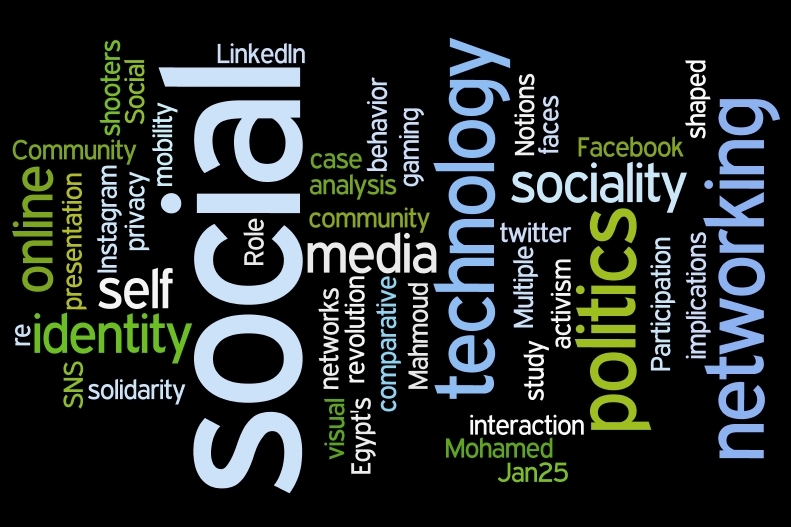
Word cloud of the student projects in the seminar “Identity, sociality & communality in times of digital media technologies” at the Department of Social and Cultural Anthropology, University of Vienna.

wordcloud

Seminar research projects

Seminar research projects published on No Comments on Seminar research projects

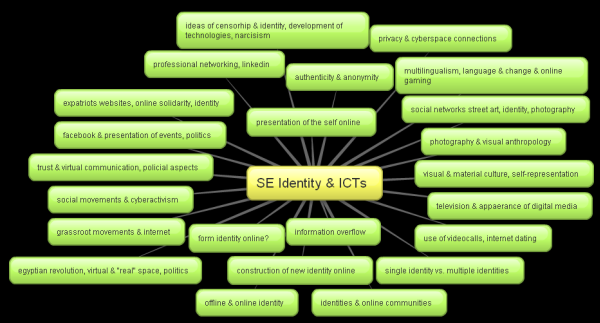
In the seminar “Identity, sociality & communality in times of digital media technologies” at the Department of Social and Cultural Anthropology, University of Vienna, students work in research teams on aspects of privacy, gaming, movements, participation, solidarity and visual culture.

mindmap

Seminar: Identity, sociality and communality in times of digital media technologies

Seminar: Identity, sociality and communality in times of digital media technologies published on No Comments on Seminar: Identity, sociality and communality in times of digital media technologies

In the winter term 2012/2013, I am teaching a seminar on “Identity, sociality and communality in times of digital media technologies” at the Department of Social and Cultural Anthropology, University of Vienna. Students in this course learn about and to work with different forms of identity construction and processes of sociality and communality, which have been made possible through digital media technologies, such as the internet. Students get a brief overview about identity concepts and the possibility to deploy them within empirical research projects.

Find more information about this seminar here: http://www.philbu.net/courses.html

Concept map: Communicative ecologies

Concept map: Communicative ecologies published on No Comments on Concept map: Communicative ecologies

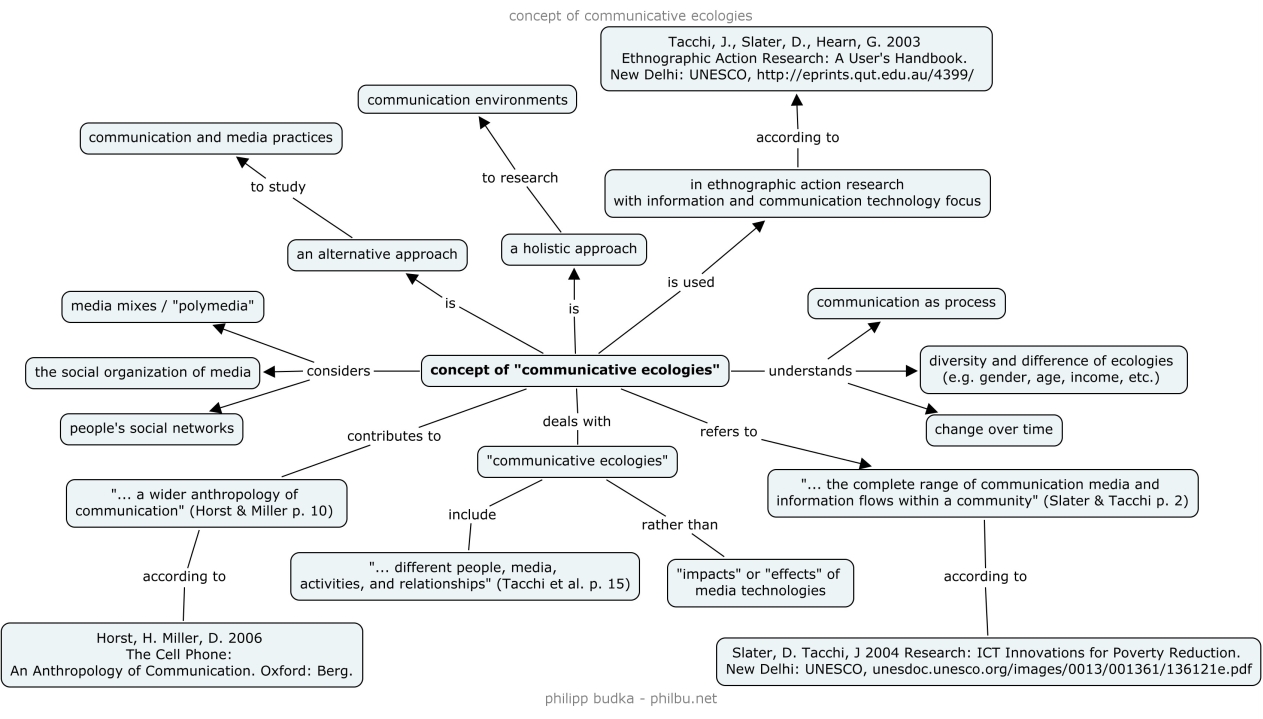
This map visualizes the concept of “communicative ecologies” as introduced by Tacchi, J., Slater, D., Hearn, G. 2003. Ethnographic Action Research: A User’s Handbook. New Delhi: UNESCO, http://eprints.qut.edu.au/4399/. It was done by using the free CMap Tools (click to enlarge).

concept map

Vortrag: Indigene Medientechnologien

Vortrag: Indigene Medientechnologien published on No Comments on Vortrag: Indigene Medientechnologien

Gastvortrag im Rahmen der Vorlesung “Einführung in die Kultur- und Sozialanthropologie” (Sommersemester 2012, Leitung: Elke Mader): “Indigene Medientechnologien – Produktion & Anwendungspraktiken aus medienanthropologischer Perspektive“: Teil 1Teil 2 (PDF)

Aus dem Inhalt:

  • Medientechnologien aus kultur- und sozialanthropologischer & ethnographischer Perspektive
  • Indigene Medien:
    Indigene?
    Indigene IKT: „outreach“ Praktiken z.B. EZLN in Mexiko, „inreach“ Praktiken: z.B. KO-NET in Kanada
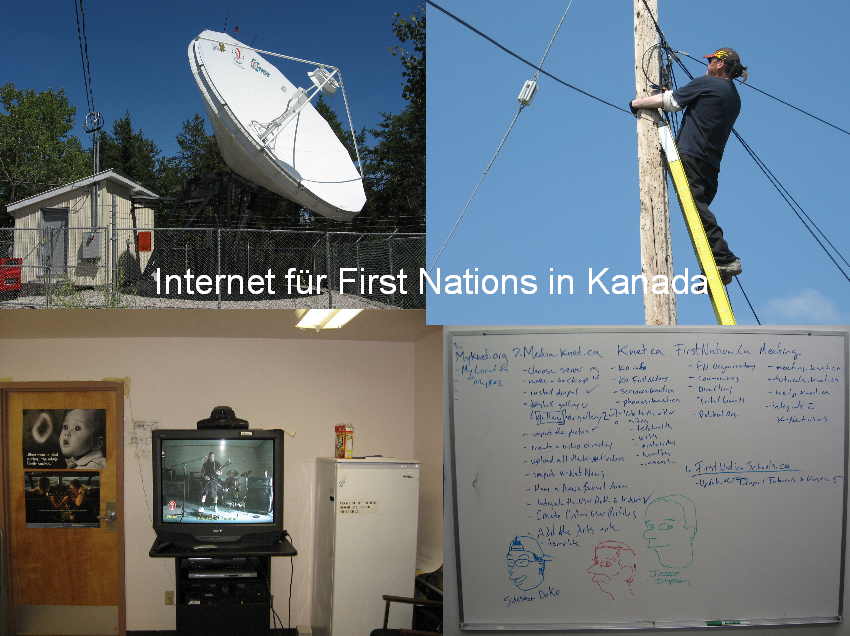
  • Indigene Medientechnologieproduktion: Beispiel „Internet für First Nations in Kanada“
  • Indigene Medienanwendungspraktiken: Beispiel „MyKnet.org: Social Networking für First Nations in Kanada“ – Identitätskonstruktion, Vergemeinschaftungsformen, ethnographische Felderforschung

Seminar: Public and Interdisciplinary Communication in Social and Cultural Anthropology

Seminar: Public and Interdisciplinary Communication in Social and Cultural Anthropology published on No Comments on Seminar: Public and Interdisciplinary Communication in Social and Cultural Anthropology

In the summer term 2012, I am organizing the seminar “Public and Interdisciplinary Communication in Social and Cultural Anthropology” at the Department of Social and Cultural Anthropology, University of Vienna. More details on the seminar’s objectives, methods and topics can be found here in German: http://www.philbu.net/courses.html#details

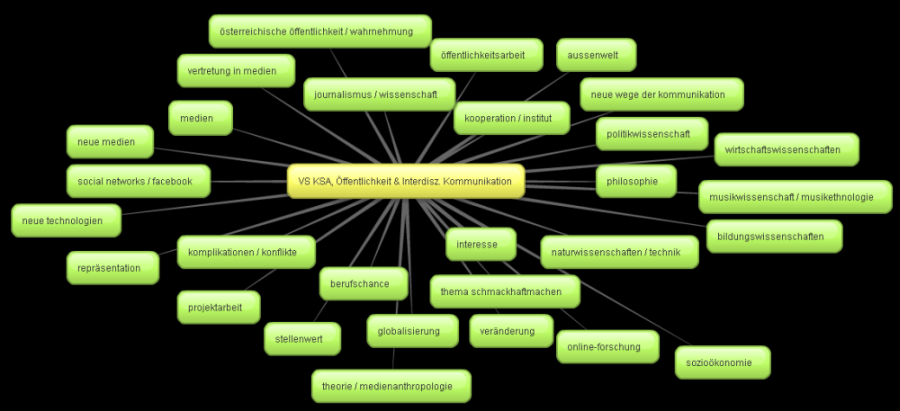
A first round of brainstorming with the students about social and cultural anthropology in relation to “the public” and forms of interdisciplinarity resulted in this mind map (German):

Ethnographie als theoretischer & epistemologischer Ansatz

Ethnographie als theoretischer & epistemologischer Ansatz published on No Comments on Ethnographie als theoretischer & epistemologischer Ansatz

Ideen und Anmerkungen zur Ethnographie als theoretischer und epistemologischer Forschungsansatz, die im Rahmen eines Jour Fixe der Gruppe Internetforschung am 09.01.2012 diskutiert wurden. Dabei wurde vor allem der Frage nachgegangen wie Ethnographie in der Internetforschung Verwendung finden kann.

Ethnographie ist eine Theorie des Beschreibens (Nader)
→ Kontext
→ Holismus → Imagination von Gesamt- oder Ganzheit

Ethnographie ist keine Methode (Ingold)
→ Ethnographie = beschreibende Integration (durch Kontextualisierung)
→ Ethnographie = Praxis verbaler Beschreibung

Praktische Aspekte / Probleme einer Ethnographie
→ Prozess der teilnehmenden Beobachtung
→ Inklusion der Forscherin / „Wir & die Anderen“
→ Wandel in Zeit & Raum
→ Hierarchien von Kontexten

Ethnographie & Interdisziplinarität (Strathern)
→ Interaktion von Disziplinen
→ Kontextspezifika entscheiden über Ethnographie → Schaffung von Kontext
→ Multi- → Inter- → Transdisziplinarität → von „information-sharing“ zu „knowledge-creation“

Literatur:
Ingold, T. 2008. Anthropology is not ethnography. In: Proceedings of the British Academy 154: 69-92. Online: http://www.proc.britac.ac.uk/cgi-bin/somsid.cgi?page=154p069&session=825683A&type=header

Nader, L. 2011. Ethnography as theory. In: HAU: Journal of Ethnographic Theory 1(1): 211-219. Online: http://www.haujournal.org/index.php/hau/article/view/34

Strathern, M. 2005. Experiments in interdisciplinarity. In: Social Anthropology 13(1): 75-90.

Paper: From Cyber to Digital Anthropology to an Anthropology of the Contemporary

Paper: From Cyber to Digital Anthropology to an Anthropology of the Contemporary published on No Comments on Paper: From Cyber to Digital Anthropology to an Anthropology of the Contemporary

Philipp Budka’s Paper at the DGV (German Anthropological Association) conference in Vienna, 14-17 September 2011, Workshop “Cyberculture” organized by Alexander Knorr

Abstract
This paper is first taking a look back on the “anthropology of cyberculture”, formulated as anthropological research area, concept and issue by Escobar in 1994. Inspired by science and technology studies, he painted a very vivid picture how anthropology and ethnography could contribute to the understanding of new bio and communication technologies as society’s transforming driving forces. Pushed by powerful digital media technologies, such as internet applications and services, anthropology labelled as “digital anthropology” is currently tempted to forget about cyberanthropology’s holistic effort of understanding the sociocultural construction and interpretation of bio and communication technologies. What is the legacy of the anthropology of cyberculture when dealing with new digital practices? Is it actually necessary to construct branches of anthropology that deal with contemporary sociocultural developments? Or should we just open the discipline to an “anthropology of the contemporary”, as Rabinow and Marcus (2008) propose?

References
Escobar, Arturo. 1994. Welcome to Cyberia. Notes on the anthropology of cyberculture. In Current Anthropology, 35/3: 211-231.
Rabinow, Paul, Marcus, George E. (with Faubion, James D., Rees, Tobias) 2008. Designs for an anthropology of the contemporary. Durham: Duke University Press.

Text (PDF)

Links
http://www.tagung2011.dgv-net.de/

http://www.tagung2011.dgvnet.de/workshops.html

http://www.univie.ac.at/ksa/

Concept map: Sociotechnical system in an anthropology of technology

Concept map: Sociotechnical system in an anthropology of technology published on No Comments on Concept map: Sociotechnical system in an anthropology of technology

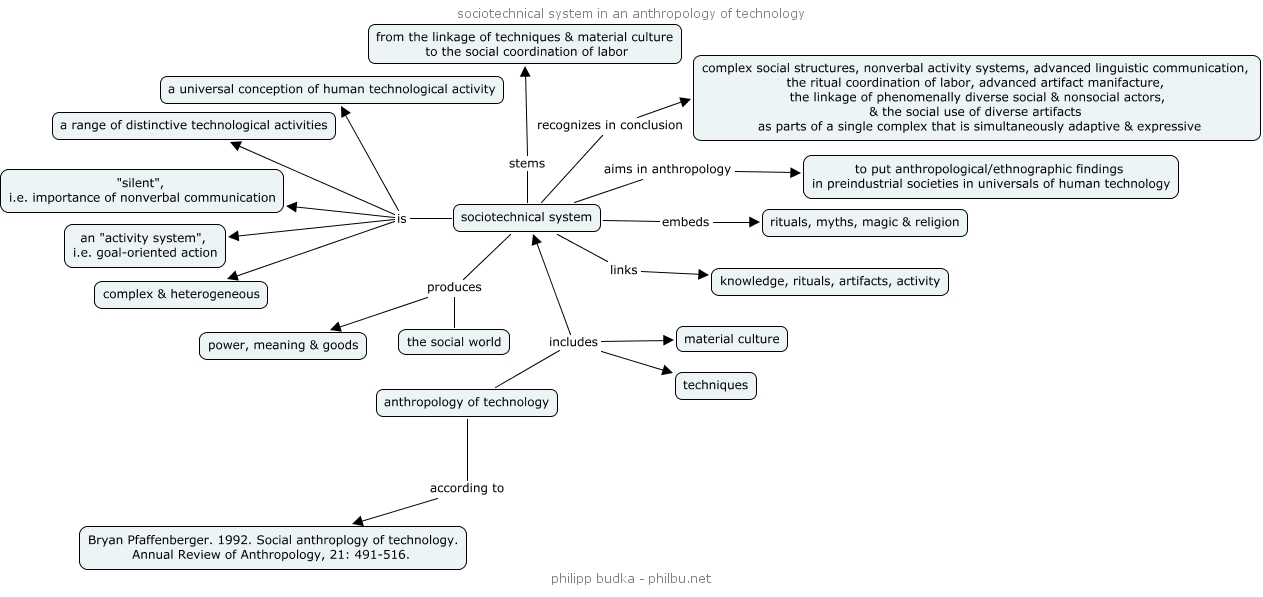
This concept map builds on Bryan Pfaffenberger’s article “Social anthropology of technology”, Annual Review of Anthropology 21(1992), pp. 491-516, in which he discusses the use of sociotechnical systems in an anthropological context. This map tries to visualize the concept. It was done by using the free CMap Tools (click to enlarge).

Primary Sidebar