Skip to content

Blog Post Series: Von der Cyberanthropologie zur Digitalen Anthropologie – Teil 2

Blog Post Series: Von der Cyberanthropologie zur Digitalen Anthropologie – Teil 2 published on No Comments on Blog Post Series: Von der Cyberanthropologie zur Digitalen Anthropologie – Teil 2

Diese Serie von Blogeinträgen beschreibt die Relevanz kultur- und sozialanthropologischer Zugänge in der Untersuchung digitaler Technik und Technologien, dargestellt anhand wissenschaftstheoretischer Aspekte in der Entwicklung der Forschungsfelder der “Cyberanthropologie” und der “Digitalen Anthropologie”. Kommentare und/oder Anmerkungen sind dezidiert erwünscht.
Die einzelnen Blogeinträge bauen, leicht verändert, auf einen Text, der 2019 im Sammelband Ritualisierung – Meditatisierung – Performance publiziert wurde:
Budka, P. (2019). Von der Cyber Anthropologie zur Digitalen Anthropologie. Über die Rolle der Kultur- und Sozialanthropologie im Verstehen soziotechnischer Lebenswelten. In M. Luger, F. Graf & P. Budka (Eds.), Ritualisierung – Mediatisierung – Performance (pp. 163-188). Göttingen: V&R Unipress/Vienna University Press. https://doi.org/10.14220/9783737005142.163

Anthropologische Perspektiven auf Technik und Technologie 2/2

Aufbauend auf Mauss (1989) versteht Sigaut (1997) Technologie als Wissenschaft und darüber hinaus als einen Zweig der Anthropologie, da technische Fakten letztlich Fakten menschlicher Aktivität sind. Technologie steht dabei zu Technik wie Wissenschaft zu den von ihr erforschten Objekten. Um nun eine “echte wissenschaftliche Technologie” zu entwickeln – Sigaut (1997: 422) spricht von “truly scientific technology” – ist es notwendig, ein Forschungsobjekt durch Beobachtung und Beschreibung zu konstruieren, ein Prozess, den er “Technographie” nennt (ebd.: 423).

Technik, im Sinne von Mauss, meint wiederum jedes Set an Bewegungen oder Handlungen, das kombiniert wird, um ein bekanntes physisches, chemisches oder organisches Ziel zu erreichen (ebd.).1 Dabei benötigt Technik Wissen und Fertigkeiten. Wissen über technische Dinge bedeutet wiederum nicht, diese auch bedienen zu können. Dazu sind bestimmte Fertigkeiten – Ingold (2000: 289ff.) spricht von “skills” – notwendig. Um nun Wissen in Fertigkeiten zu transformieren, bedarf es eines Lernprozesses über unterschiedlich lange Zeiträume. Für Sigaut (1997: 445) können diese Fertigkeiten grundsätzlich nicht getrennt von permanenter und sich beständig erneuernder (sozialer) Handlungspraxis existieren. Technische Fertigkeiten lassen sich so als sozial produziert und darüber hinaus als eng mit materiellen Gütern verbunden verstehen. Die Anthropologie blickt nun genau auf diese soziotechnischen Beziehungen, die nach Sigaut die interessantesten Antworten auf technische und technologische Phänomene und Probleme in unseren Gesellschaften versprechen.

So wird in der Anthropologie etwa das Konzept des soziotechnischen Systems verwendet, um die genannten Phänomene gemeinsam und in ihrem Zusammenhang zu untersuchen. Dabei wird, wie bereits dargelegt, ein deterministisches Technologieverständnis – die Vorstellung, dass Technologie eine alles dominierende Kraft und entsprechende Handlungsautonomie besitzt – ebenso abgelehnt wie die Sichtweise, dass Technologie “neutral” ist und es keinerlei Verbindung zwischen Technik, Technologie, Gesellschaft und Kultur gäbe. Ein soziotechnisches System lässt sich als ein Komplex unterschiedlicher, miteinander verbundener Elemente verstehen: soziale Strukturen, Koordination und Organisation von Arbeit, soziale Beziehungen und Kommunikation zwischen AkteurInnen sowie Produktion und Verwendung von Artefakten. Dieses Gefüge von soziotechnisch relevanten Phänomenen ist dabei gleichzeitig adaptiv – das heißt anpassungs- und lernfähig – sowie expressiv – also ausdrucksfähig (Pfaffenberger 1992: 513).

Technologie wird in der Anthropologie (z. B. Eglash 2006) und in anderen Sozialwissenschaften (z. B. Vannini 2009) aber auch als materielle Kultur verstanden. Materielle Kultur lässt sich nach Daniel Miller (1997: 399) als die materielle Form jenes kulturellen Prozesses verstehen, durch den sich menschliche Gruppen konstruieren und sozialisieren. So erlaubt dieser Zugang, die Materialität und die Normativität von Technologien anhand ihrer Inkorporation in den soziokulturellen Alltag zu fassen. Wie sich in der anthropologischen und ethnographischen Forschungspraxis zeigt, ist die Materialität von Technologie mit phänomenologischen Erfahrungen verknüpft, über die soziale Verbindungen und (neue) Beziehungen zu Zeit und Raum sowie zu Körper und Wahrnehmung hergestellt werden (z.B. Ginsburg/Abu-Lughod/Larkin 2002).

Continue reading Blog Post Series: Von der Cyberanthropologie zur Digitalen Anthropologie – Teil 2

Blog Post Series: Von der Cyberanthropologie zur Digitalen Anthropologie – Teil 2
Blog Post Series: Von der Cyberanthropologie zur Digitalen Anthropologie – Teil 2 published on No Comments on Blog Post Series: Von der Cyberanthropologie zur Digitalen Anthropologie – Teil 2
Diese Serie von Blogeinträgen beschreibt die Relevanz kultur- und sozialanthropologischer Zugänge in der Untersuchung digitaler Technik und Technologien, dargestellt anhand wissenschaftstheoretischer Aspekte in der Entwicklung der Forschungsfelder der “Cyberanthropologie” und der “Digitalen Anthropologie”. Kommentare und/oder Anmerkungen sind dezidiert erwünscht.
Die einzelnen Blogeinträge bauen, leicht verändert, auf einen Text, der 2019 im Sammelband Ritualisierung – Meditatisierung – Performance publiziert wurde:
Budka, P. (2019). Von der Cyber Anthropologie zur Digitalen Anthropologie. Über die Rolle der Kultur- und Sozialanthropologie im Verstehen soziotechnischer Lebenswelten. In M. Luger, F. Graf & P. Budka (Eds.), Ritualisierung – Mediatisierung – Performance (pp. 163-188). Göttingen: V&R Unipress/Vienna University Press. https://doi.org/10.14220/9783737005142.163

Anthropologische Perspektiven auf Technik und Technologie 1/2

Seit Jahrzehnten untersuchen Kultur- und SozialanthropologInnen neue und “moderne” Techniken und Technologien und wie diese vor allem in “nichtwestlichen” Gesellschaften verwendet und angeeignet werden (z.B. Godelier 1971; Pfaffenberger 1992; Sharp 1952). Doch, wie etwa Arturo Escobar (1994) betont, gestaltet es sich oft schwierig, diese Forschungsansätze und -befunde auf hoch komplexe, technische Umgebungen in “modernen” Gesellschaften zu übertragen. Aus anthropologischer Perspektive bedeutet diese Transferschwierigkeit aber weder eine Abwertung von spezifischen Techniken oder Technologien und damit verbundenen gesellschaftlichen und kulturellen Systemen noch deren Hierarchisierung, etwa in einem evolutionistischen Sinn (z. B. Ingold 2000). All diese soziotechnischen Phänomene sind hoch komplex und heterogen.

Um diese Phänomene und damit zusammenhängende soziale Praktiken und kulturelle Prozesse an den Schnittstellen von Gesellschaft, Wissenschaft und Technik zu analysieren und zu verstehen, ist es notwendig, passende theoretische Zugänge und Konzepte zu generieren sowie empirische Befunde zu sammeln (z. B. Fischer 2007; Pfaffenberger 1992). Wie Robert Adams (1996: xiii) festhält, erlaubt gerade die Anthropologie als wissenschaftliche Disziplin eine spezifische, offene Sichtweise auf Technik und Technologie, die wesentliche Vorzüge hat. Erstens vermeidet sie eine Reduktion auf simple Regularitäten und messbare Quantitäten im Verstehen komplexer soziotechnischer Interaktionen. Weiters werden integrative und kontextbezogene Zugänge betont, um soziotechnischen Wandel und soziotechnische Kontinuität zu untersuchen. Und drittens erlaubt der Fokus auf Diversität scheinbar allgemein akzeptierte Kategorisierungen und Beschreibungen von soziokulturellen Phänomenen kritisch zu hinterfragen.

So setzt beispielsweise Bryan Pfaffenberger (1988b: 244) den beiden Extrempositionen des “technologischen Somnambulismus”, die keinen kausalen Zusammenhang zwischen Technologie, Gesellschaft und Kultur erkennen will, und des “technologischen Determinismus”, die Technologie als die alles bestimmende gesellschaftliche Antriebskraft versteht, das Konzept der “humanisierten Natur” entgegen, das Technologie als soziokulturelles Konstrukt versteht, das der Mensch aus seiner ihn umgebenden Natur gestaltet. Dieses Technologieverständnis versucht deterministische Zugänge ebenso zu vermeiden wie die damit verbundene Fetischisierung von Technologie (Budka 2013). Technologie als “humanisierte Natur” ist laut Pfaffenberger (1988b) ein fundamental soziales – oder angelehnt an Marcel Mauss (1989) ein “totales” – Phänomen, das das Materielle, das Soziale und das Symbolische in einem assoziativen Netz kombiniert.

Die Überzeugung, dass technische und gesellschaftliche Phänomene nicht getrennt voneinander zu untersuchen und zu verstehen sind, ist also grundlegend für die Anthropologie wie auch für die Wissenschafts- und Technikforschung sowie die Techniksoziologie (z. B. Bijker/Law 1992; Degele 2002). Aufgrund der Komplexität der Thematik ist es auch schwierig, eine allgemein gültige Definition von Technik bzw. Technologie zu finden. So meint etwa François Sigaut (1997: 422), dass sich letztlich viele Bemühungen, Technologie zu definieren, als widersprüchlich und damit als nutzlos herausstellen. Und Tim Ingold (2000: 296f.) konstatiert grundlegende Unterschiede in den Versuchen, Technologie zu definieren, die vorrangig davon abhängig sind, wie umfassend diese Definitionen angelegt werden und wie das Verhältnis zwischen Technologie und Wissenschaft interpretiert wird.

Blog Post Series: Von der Cyberanthropologie zur Digitalen Anthropologie – Teil 1

Blog Post Series: Von der Cyberanthropologie zur Digitalen Anthropologie – Teil 1 published on No Comments on Blog Post Series: Von der Cyberanthropologie zur Digitalen Anthropologie – Teil 1

In dieser Serie von Blogeinträgen werde ich in den kommenden Wochen die Relevanz kultur- und sozialanthropologischer Zugänge in der Untersuchung digitaler Technik und Technologien, dargestellt anhand wissenschaftstheoretischer Aspekte in der Entwicklung der Forschungsfelder der “Cyberanthropologie” und der “Digitalen Anthropologie”, verdeutlichen. Kommentare und/oder Anmerkungen sind dezidiert erwünscht.
Die einzelnen Blogeinträge bauen, leicht verändert, auf einen Text, der 2019 im Sammelband Ritualisierung – Meditatisierung – Performance publiziert wurde:
Budka, P. (2019). Von der Cyber Anthropologie zur Digitalen Anthropologie. Über die Rolle der Kultur- und Sozialanthropologie im Verstehen soziotechnischer Lebenswelten. In M. Luger, F. Graf & P. Budka (Eds.), Ritualisierung – Mediatisierung – Performance (pp. 163-188). Göttingen: V&R Unipress/Vienna University Press. https://doi.org/10.14220/9783737005142.163

Digitale Technik und Technologien haben das Menschsein verändert, und Menschen gestalten und verändern laufend Technik und Technologien. Diese Serie von Blogeinträgen zeigt, wie die Kultur- und Sozialanthropologie, als Wissenschaft vom sozialen und kulturellen Menschen, den wissenschaftstheoretischen Zugang sowie die Methodenwahl mitgestaltet, um diese komplexe Beziehung zu erfassen, zu beschreiben und letztlich zu verstehen. Dabei wird auch sie von Entwicklungs- und Veränderungsprozessen geprägt, die als soziotechnisch – im Sinne der engen Verknüpfung zwischen dem Sozialen und dem Technischen, zwischen Gesellschaft, Technik und Technologie – bezeichnet werden können.

So ist die Kultur- und Sozialanthropologie längst nicht mehr nur die Wissenschaft von “einfachen außereuropäischen Kulturen”.2 Seit Jahrzehnten forschen ihre VertreterInnen, zumeist vergleichend, zu komplexen Phänomenen, Prozessen und Veränderungen in unterschiedlichsten menschlichen Gesellschaften. Da war es nur eine Frage der Zeit, bis die ersten AnthropologInnen begannen, sich mit technischen Entwicklungen und wissenschaftlichen Praktiken in Europa und den USA auseinander zu setzen (z. B. Fischer 1999, 2007; Pfaffenberger 1988b, 1992).

So kamen schrittweise digitale Informations-, Kommunikations- und Medientechnologien und mit diesen verbundene Prozesse und Praktiken in den Fokus anthropologischer Forschung: von der allgemeinen kulturellen und gesellschaftlichen Bedeutung digitaler Technologieentwicklung und deren Relevanz für das Menschsein und die Disziplin der Anthropologie (z. B. Dourish/Bell 2011; Escobar 1994; Hakken 1999; Houtman/Zeitlyn 1996; Miller 2018; Miller/Horst 2012; Uimonen 2015; Whitehead/Wesch 2012a) bis hin zur Untersuchung von spezifischen Zusammenhängen zwischen digitalen Technologien und soziokulturellen Phänomenen, wie Konflikt (Bräuchler 2005) und Ethnizität (Zurawski 2000) im Internet, Veränderungen der Arbeitswelt (Kjaerulff 2010) und menschlicher Kommunikationsweisen (Schröder/Voell 2002) oder die kulturelle Bedeutung Freier Software (Kelty 2008).

Continue reading Blog Post Series: Von der Cyberanthropologie zur Digitalen Anthropologie – Teil 1

Publications: E-learning & blended learning in anthropology & the social sciences

Publications: E-learning & blended learning in anthropology & the social sciences published on No Comments on Publications: E-learning & blended learning in anthropology & the social sciences

Here a collection of publications that discuss the development and utilization of e-learning and blended learning tools and models for sociocultural anthropology and the social sciences. These publications are the result of different projects conducted at the Department of Social and Cultural Anthropology as well as the Dean’s Office of the Faculty of Social Sciences of the University of Vienna.

Budka, P., Schallert, C., & Mader, E. (2011). Interactive technology enhanced learning for social science students. In M. E. Auer & M. Huba (Eds.), Proceedings of the 14th International Conference on Interactive Collaborative Learning (ICL2011) (pp. 274-278), CD-ROM. Piscataway, NJ: IEEE. Abstract & Text.

Budka, P., & Schallert, C. (2009). Transforming learning infrastructures in the social sciences through flexible and interactive technology-enhanced learning. Learning Inquiry, 3(3), 131-142. https://doi.org/10.1007/s11519-009-0045-9

Budka, P., Mader, E., Anderl, E., & Stockinger, J. (2008). Strategies for networked learning in social science education. In J. Luca & E. R. Weippl (Eds.), Proceedings of ED-MEDIA 2008: World Conference on Educational Multimedia, Hypermedia and Telecommunications (pp. 618-622). Chesapeake, VA: AACE.

Continue reading Publications: E-learning & blended learning in anthropology & the social sciences

Seminar: Digital Technologies as Material Culture 2020

Seminar: Digital Technologies as Material Culture 2020 published on No Comments on Seminar: Digital Technologies as Material Culture 2020

In this MA seminar at the Department of Social and Cultural Anthropology, University of Vienna, we explore digital media technologies from an anthropological/ethnographic perspective in the context of material culture.
More info

This course gives an overview about material culture as a conceptual and practical approach to understand digital technologies. In doing so, it focuses on the everyday incorporation and utilization of digital technologies.

Mobile networked digital media technologies, such as smart phones, as well as social media platforms and services, such as Facebook or Instagram, have become important (visual) communication and (re)presentation tools. For social and cultural anthropology it is of particular interest how these digital devices and technologies are integrated and embedded into everyday life, by considering changing sociocultural, political and economic contexts. This course focuses in particular on the material aspects of digital technologies and how they are utilized on a day-to-day basis. Questions about the relevance of a material culture approach for (the understanding of) technology appropriation – on a theoretical and practical level – as well as questions about (culturally) different usage practices are discussed. How does the understanding and conceptualization of digital technology as material culture contribute to the exploration and analyses of contemporary and emerging sociocultural practices and processes in increasingly digital societies?

By working on different online case studies, students get a comparative overview about material culture in a digital context.

Continue reading Seminar: Digital Technologies as Material Culture 2020

Book: Theorising Media and Conflict

Book: Theorising Media and Conflict published on No Comments on Book: Theorising Media and Conflict

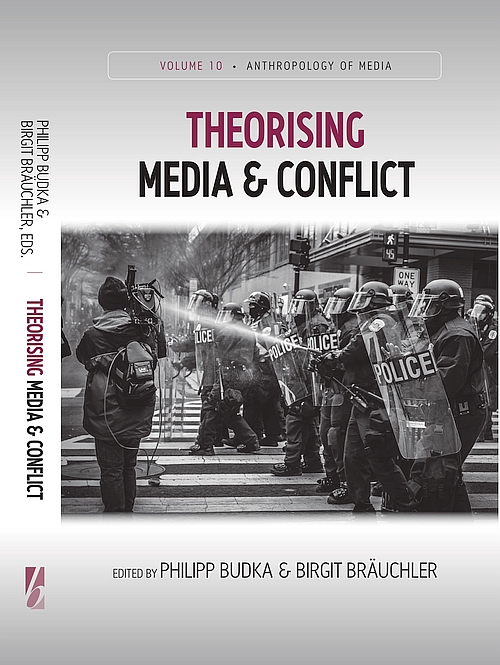
Budka, P., & Bräuchler, B. (Eds.). (2020). Theorising media and conflict. Anthropology of Media. New York & Oxford: Berghahn Books.

Theorising Media and Conflict brings together anthropologists as well as media and communication scholars to collectively address the elusive and complex relationship between media and conflict. Through epistemological and methodological reflections and the analyses of various case studies from around the globe, this volume provides evidence for the co-constitutiveness of media and conflict and contributes to their consolidation as a distinct area of scholarship. Practitioners, policymakers, students and scholars who wish to understand the lived realities and dynamics of contemporary conflicts will find this book invaluable.

This is the second “Theorising media and …” book in Berghahn’s Anthropology of Media series. The aim of the series is to place media anthropology at the forefront of theoretical advances in both anthropology and media and communication studies.

Table of Contents

Preface
Philipp Budka

PART I: KEY DEBATES
Introduction. Anthropological Perspectives on Theorising Media and Conflict
Birgit Bräuchler and Philipp Budka
Chapter 1. Transforming Media and Conflict Research
Nicole Stremlau

PART II: WITNESSING CONFLICT
Chapter 2. Just a ‘Stupid Reflex’? Digital Witnessing of the Charlie Hebdo Attacks and the Mediation of Conflict
Johanna Sumiala, Minttu Tikka and Katja Valaskivi
Chapter 3. The Ambivalent Aesthetics and Perception of Mobile Phone Videos: A (De-)Escalating Factor for the Syrian Conflict
Mareike Meis

Continue reading Book: Theorising Media and Conflict

CfP: Engaged media anthropology in the digital age

CfP: Engaged media anthropology in the digital age published on No Comments on CfP: Engaged media anthropology in the digital age

The EASA Media Anthropology Network is organizing an official network panel at the European Association of Social Anthropologists (EASA) 2020 conference in Lisbon (21-24 July). Find the call for papers below and online:
https://nomadit.co.uk/conference/easa2020/p/8591

For more general information about the call and the conference, navigate to:
https://easaonline.org/conferences/easa2020/cfp
https://easaonline.org/conferences/easa2020/

The call closes on 20 January 2020.

Engaged media anthropology in the digital age

Organizers
Philipp Budka (University of Vienna) and Sahana Udupa (LMU Munich)

Abstract
The relative ease of access and potential disruptive features of digital media have opened up new opportunities for media anthropologists to extend their field relations into durable public engagement. These possibilities have encouraged anthropologists to collaboratively design various public engagement initiatives to harness digital media technologies and infrastructures for social justice goals including health, education, environmental protection, gender parity and political inclusion. Such direct interventions have gone hand in hand with critical perspectives on how “the digital” has played a key role in enabling political cultures of indignity and injustice – from online extreme speech to digitally enabled surveillance and algorithmic bias. This panel will foreground these two distinct, yet interrelated, aspects of engaged media anthropology: community projects that involve direct participation of anthropologists in designing digital platforms and applications, and in supporting local forms of media/digital activism; and studies that envision an inclusive future through public intervention strategies of critique and discursive resistance. A key question that drives this panel is whether the latest examples of engaged media anthropology that are enabled by digital technologies and infrastructures have signaled a break from the imperial logic of upliftment and betterment as a means to consolidate colonial power or whether enduring injustices are questioned through new means of collaboration and dialogue. What are the promises and limitations of engaged media anthropology in the digital age?

Lecture/Seminar: Ethnography and Digital Media 2019

Lecture/Seminar: Ethnography and Digital Media 2019 published on No Comments on Lecture/Seminar: Ethnography and Digital Media 2019

In this lecture/seminar at the Department of Social and Cultural Anthropology, we discuss how ethnography contributes to the exploration, description and understanding of digitally mediated processes and practices (in German).

In dieser Lehrveranstaltung erhalten Studierende einen Einblick in die Ethnographie digitaler Medien. Dabei werden sowohl theoretische Zugänge und Konzepte als auch praxisnahen Anwendungs- und Erfahrungswerte vermittelt.

Digitale Medien – wie Internet, Social Media und Smartphones – ermöglichen neue Formen medialer Kommunikation und Repräsentation, die in Zusammenhang mit unterschiedlichen soziokulturellen, politischen und ökonomischen Faktoren und Dimensionen stehen. Diese Medientechnologien überbrücken nicht nur Zeit und Raum, sie gestalten diese neu. Sie ermöglichen die Vernetzung und Mobilisierung von Menschen und die Konstruktion vielfältiger Formen von individueller und kollektiver Identität. Welche theoretischen und methodologischen Zugänge sind hilfreich, um neue digitale Medientechnologien und damit zusammenhängende Praktiken und Sozialitäten zu beschreiben und zu analysieren? Können wir auf das “klassische” methodische Repertoire der Kultur- und Sozialanthropologie zurückgreifen oder benötigt es neue digitale Methoden und Techniken? Welche Bedeutung haben etwa Datensicherung und die Archivierung von digitalen Artefakten? Und welche ethischen Aspekte in der Digitalen Ethnographie gilt es zu beachten?
Studierende lernen anhand von konkreten Fallbeispielen, ausgewählte theoretische und methodologische Zugänge kennen. Sie gewinnen so einen Überblick über die Diversität digitaler Phänomene, Prozesse und Praktiken sowie deren ethnographische Beschreibung und Untersuchung.

Literatur (Auswahl)

Boellstorff, T., Nardi, B., Pearce, C., & Taylor, T. L. (2012). Ethnography and virtual worlds: A handbook of method. Princeton: Princeton University Press.

Budka, P. (2019). Von der Cyber Anthropologie zur Digitalen Anthropologie. Über die Rolle der Kultur- und Sozialanthropologie im Verstehen soziotechnischer Lebenswelten. In M. Luger, F. Graf & P. Budka (Eds.), Ritualisierung – Mediatisierung – Performance (pp. 163-188). Göttingen: V&R Unipress/Vienna University Press.

Hakken, D. (1999). Cyborgs@Cyberspace: An ethnographer looks to the future. London: Routledge.

Hjorth, L, Horst, H., Galloway, A., & Bell, G. (2016). The Routledge Companion to digital ethnography. New York: Routledge.

Miller, D., & Slater, D. (2002). Ethnography and the extreme Internet. In T. H. Eriksen (Ed.), Globalisation: Studies in anthropology (pp. 39-57). London: Pluto Press.

Pink, S., Horst, H., Postill, J., Hjorth, L., Lewis, T., & Tacchi, J. (2016). Digital ethnography: Principles and practice. Thousand Oaks, CA: Sage.

Postill, J., & Pink, S. (2012). Social media ethnography: The digital researcher in a messy web. Media International Australia, 145(1), 123-134.

More info: https://ufind.univie.ac.at/en/course.html?lv=240033&semester=2019W

Lecture: Introduction to Social and Cultural Anthropology 2019

Lecture: Introduction to Social and Cultural Anthropology 2019 published on No Comments on Lecture: Introduction to Social and Cultural Anthropology 2019

In this year’s introductory lecture at the Department of Social and Cultural Anthropology of the University of Vienna, we will investigate and discuss sociocultural anthropology’s key topics, selected theoretical perspectives and a diversity of case studies (in German). This lecture is closely connected to the lecture “Propädeutikum Social and Cultural Anthropology” and focuses in particular on teaching and research areas that are representative for sociocultural anthropology in Vienna.

In der Vorlesung wird eine Auswahl von Themenfeldern behandelt, die im Zuge des Studiums in diversen Modulen vertieft werden. Dazu zählen: Kolonialismus/Postkolonialismus; Globalisierung und Migration; Tourismus; ökonomische Prozesse und Wirtschaftsweisen; Materielle Kultur und Konsum; Natur und Umwelt; soziale Organisationsformen und Kinship; Ritual und Mythen; Religion und Weltbild; Medien und Kommunikationstechnologien; Visuelle Kultur und Film; Gender.

Die Darstellung der einzelnen Themenfelder umfasst jeweils eine Einführung in wichtige Fragestellungen, zentrale theoretische Konzepte, und ausgewählte Fallstudien. Besondere Aufmerksamkeit gilt dabei auch den Verflechtungen von verschiedenen Themenfeldern sowie spezifischen regionalen Kontexten (insbesondere Lateinamerika, Nordamerika, Südasien und Nordafrika).

Die Vorlesung gibt den Studierenden einen Einblick in die thematische Bandbreite des Faches, sie vermittelt Basiswissen zu Orientierung von StudienanfängerInnen sowie Grundkompetenzen in Hinblick auf eine Reihe von aktuellen Forschungsfeldern der Kultur- und Sozialanthropologie.

More info: https://ufind.univie.ac.at/de/course.html?lv=240002&semester=2019W


Presentation: MyKnet.org: The cultural history & social life of an indigenous web-based environment

Presentation: MyKnet.org: The cultural history & social life of an indigenous web-based environment published on No Comments on Presentation: MyKnet.org: The cultural history & social life of an indigenous web-based environment

Budka, P. (2019). MyKnet.org: The cultural history and social life of an indigenous web-based environment. Paper at “The Web That Was: Archives, Traces, Reflections” Conference (RESAW19), Amsterdam, Netherlands: University of Amsterdam, 21 June. Presentation (PDF)

Ethnographic Vignette

In the summer of 2006, during my first field trip to Northwestern Ontario, I visited the Frenchman’s Head community of Lac Seul First Nation which is one of the region’s few non-remote indigenous communities that can be reached by car and by boat. In the Band Office, the community’s largest administrative building, I was introduced to 16 year old Candice, a well known MyKnet.org user. She told me that she did set up her first MyKnet.org page a couple of years ago to stay in touch with friends and family and to let people know about her life. To communicate with friends and family members, she added a c-box to her homepage where people could leave messages.

As I found out later, almost everyone in the Band Office had a MyKnet.org homepage. Even though some didn’t know how to work with their websites. They needed the help of young, web-savvy colleagues, friends and family members. Candice introduced me to an older lady who told me that she had to register for a new MyKnet.org page only two weeks ago because her original page was registered under her now divorced husband’s name. And since she didn’t want to be constantly reminded of this, she needed a new homepage. KO-KNET, the First Nations internet organization that has been managing the MyKnet.org homepage service, only approves registrations with real, locally known, First Nation names that are then displayed in the URL of the page.

Candice helped her setting up the page, finding and applying the right layout and updating the content. As she told me later, she was regularly reminding other employees at the office to keep their respective homepages up to date. She also told me that she has started to use other, commercial website providers, such as Piczo (2002-2012). They were easier to use than MyKnet.org and provided more web space and technical features and possibilities.

Seminar: Media Activism

Seminar: Media Activism published on No Comments on Seminar: Media Activism

For the MA Program “Visual and Media Anthropology” at the Free University Berlin, I am organizing a newly developed seminar on media activism.

Course Description

Activism with/in/through media can be broadly understood as forms of technology mediated activism that intend to spark, create and/or support social and political change. So change (and therefore continuity) is at the heart of media activism, as, for instance, Kidd and Rodriguez (2009: 1) note: “Grassroots media have grown from a set of small and isolated experiments to a complex of networks of participatory communications that are integral to local, national, and transnational projects of social change”. Since media activism is related to a diversity of phenomena – such as power relationships, conflict or globalization – as well as to questions about the conception of time and space, organizational structures, collective identities and different forms of sociality, it has become a broad, interdisciplinary research field. This course gives an overview of media activism from a predominantly anthropological and ethnographic perspective.

When engaging with media activism, a variety of contexts, theoretical conceptualizations and methodological approaches have to be considered. In this course, students learn about these aspects by reviewing relevant literature and by discussing different forms and examples of media activism and related questions, issues and problems:

  • How can we contextualize media activism and related practices in anthropology?
  • What historical developments can we identify? And what does this tell us about contemporary activist processes and practices?
  • What is the role of (sociocultural and technological) change, politics, power, globalization and (de)colonization in an anthropological engagement with media activism?
  • How can we ethnographically describe and analyze media activist processes and practices? What are the possibilities and challenges?
  • How can we understand media activism in digital times and in the age of social media? What has changed?
  • What does it mean to interpret and conceptualize media activism as (a form or a part of) cultural activism?

Reference

Kidd, D., & Rodriguez, C. (2009). Introduction. In C. Rodriguez, D. Kidd, & L. Stein (Eds.), Making our media: Global initiatives toward a democratic public sphere, Volume 1: Creating new communication spaces (pp. 1-22). New York: Hampton Press.

Continue reading Seminar: Media Activism

Book: Ritualisierung – Mediatisierung – Performance

Book: Ritualisierung – Mediatisierung – Performance published on No Comments on Book: Ritualisierung – Mediatisierung – Performance

Luger, M., Graf, F., & Budka, P. (Eds.). (2019). Ritualisierung – Mediatisierung – Performance. (Ritualization – Mediatization – Performance). Göttingen: V&R Unipress/Vienna University Press.

Abstract
Ritualisierung, Mediatisierung und Performance dienen als konzeptionelle Hilfsmittel, um Veränderungen und Kontinuitäten im Alltagsleben sozialer Akteurinnen und Akteure sowie in spezifischen Kontexten zu situieren. Dieser Band zeigt anhand konkreter ethnographischer Beispiele, dass rituelle, mediale und performative Prozesse und Praktiken idealerweise gemeinsam, in ihrer Relationalität zueinander betrachtet werden. Neben einem Schwerpunkt auf Transformation enthält der Band Beiträge zu ausgewählten Aspekten der Theorie, Methode und Geschichte der Kultur- und Sozialanthropologie und zu einer Ethnographie und Kulturgeschichte der Karibik, die sozialen Status, religiöse Praxis und Erinnerung behandeln sowie Texte, die Verbindungen zwischen politischen, medialen und kulturellen Sphären diskutieren.

Ritualization, mediatization and performance are conceptual tools to situate sociocultural change and continuity in everyday life and in specific contexts. By building on ethnographic case studies, this volume demonstrates that ritual, media and performative processes and practices are best explored in relation to each other. In addition to a general focus on transformation, this book includes contributions on selected aspects of the theory, methodology and history of social and cultural anthropology. Chapters about the history and ethnography of the Caribbean that discuss social status, religious practices and cultural remembrance, as well as texts that explore the connections between political, media and cultural spheres complement the volume.

Inhaltsverzeichnis
Martin Luger / Philipp Budka / Franz Graf
Kultur- und sozialanthropologische Perspektiven auf Ritualisierung, Mediatisierung und Performance. Eine Einleitung
Marion Linska
Selbstfürsorge im Feld. Überlegungen aus existenzanalytischer Perspektive
Yvonne Schaffler / Bernd Brabec de Mori
»Cuando el misterio insiste« – »Wenn sich der Geist Gehör verschafft«. Die Kunst der Überzeugung im dominikanischen Vodou
Stephanie Schmiderer
Präsenz der Gottheiten. Zum Verständnis transformativer Performance im haitianischen Vodou und seiner Diaspora
Elke Mader
Rund um die Palme. Rituelle Prozesse, indigene Politik und Medien in Ecuador
Birgit Bräuchler
Praxeologische Überlegungen zur Mediatisierungsdebatte. Eine ethnologische Perspektive
Philipp Budka
Von der Cyberanthropologie zur Digitalen Anthropologie. Über die Rolle der Kultur- und Sozialanthropologie im Verstehen soziotechnischer Lebenswelten
Manfred Kremser
»Shango is a Powerful Fellow!«. Repräsentation spiritueller Macht in afrokaribischen Kulturen
Adelheid Pichler
Artefakte und Erinnerung. Ein Beitrag zur Interpretation materieller Kultur in den afrokubanischen Religionen
Werner Zips
»She’s Royal« – »Queenmothers« in Ghana. Ein afrikanisches Rollenmodell für Jamaika
Manfred Kremser / Franz Graf / Gertraud Seiser
»Ein Leben scannen«. Fragmentarische Retrospektive von und auf Manfred Kremser

Article: Indigenous Media Technologies in “The Digital Age”

Article: Indigenous Media Technologies in “The Digital Age” published on No Comments on Article: Indigenous Media Technologies in “The Digital Age”

Budka, P. (2019). Indigenous media technologies in “the digital age”: Cultural articulation, digital practices, and sociopolitical concepts. In S. S. Yu & M. D. Matsaganis (Eds.), Ethnic media in the digital age (pp. 162-172). New York: Routledge.

Introduction
Indigenous engagements with digital media technologies have been analyzed from different angles and by discussing a variety of issues, from technology access and literacy, to language, culture, and politics (e.g., Dyson, Grant, & Hendriks, 2016; Dyson, Hendriks, & Grant, 2007; Landzelius, 2006a). By drawing on a literature review and on an ethnographic case study, I am providing an anthropological perspective on the relationship between indigenous people and digital media technologies that focuses on digital practices related to the mediation of culture and the formation of (cultural) identity. Within this mediation process, cultural elements of the dominant, non-indigenous societies are recombined with elements from indigenous cultures. “Indigenized” media technologies promote thus an open and dynamic understanding of culture in “the digital age.” But when it comes to characterizing and understanding non-Western media phenomena and processes, terms such as “the digital age” or “the network society” have their conceptual weaknesses. These concepts are inherently ethnocentric, that is, Euro-American centered, implying an evolutionary world view that tends to ignore culturally different ascriptions of meaning to digital realities. I am following here Ginsburg (2008), who states that these concepts are rather reinforcing the imaginary of “the other,” existing in “a time not contemporary with our own” (p. 291). Thus, this chapter presents an anthropologically informed approach to the relationship between media technologies, culture, and politics that advocates the significance of non-Western perspectives and realities in conceptualizing and understanding the diversity of digital life.

Seminar: Digital & Visual Technologies as Material Culture

Seminar: Digital & Visual Technologies as Material Culture published on No Comments on Seminar: Digital & Visual Technologies as Material Culture

In the summer term 2019, I am giving a seminar on digital and visual technologies as material culture at the Department of Social and Cultural Anthropology (MA & CREOLE study programme) of the University of Vienna. Find more information online.

This course gives an overview about material culture as a conceptual and practical approach to understand digital and visual technologies. In doing so, it focuses on digital technologies, their visual aspects and how they are integrated and utilized in everyday life.

Mobile networked digital media technologies, such as smart phones, as well as social media platforms and services, such as Facebook or Instagram, have become important (visual) communication and (re)presentation tools. For social and cultural anthropology it is of particular interest how these digital devices and technologies are integrated and embedded into everyday life, by considering changing sociocultural, political and economic contexts. This course focuses in particular on the material aspects of digital and visual technologies and how they are utilized on a day-to-day basis. Questions about the relevance of a material culture approach for (the understanding of) technology appropriation on a theoretical and practical level as well as questions about (culturally) different usage practices are discussed. How does the understanding and conceptualisation of digital and visual technology as material culture contribute to the exploration and analyses of contemporary and emerging sociocultural practices and processes in increasingly digital societies?

By working on different case studies, students get a comparative overview about material culture in the context of digital and visual technologies. Students conduct small empirical research projects within teams.

Lecture: Ritual & Religion in Social and Cultural Anthropology

Lecture: Ritual & Religion in Social and Cultural Anthropology published on No Comments on Lecture: Ritual & Religion in Social and Cultural Anthropology

Together with Martin Luger, I am organizing a lecture on ritual and religion in social and cultural anthropology at the Department of Social and Cultural Anthropology of the University of Vienna (in German). Find more information online.

Die Lehrveranstaltung gibt einen Überblick über zentrale Konzepte der Kultur- und Sozialanthropologie zu rituellen und religiösen Praktiken, Prozessen und Phänomenbereichen. Ausgehend von klassischen Werken unterschiedlicher Denktraditionen werden den Studierenden Einblicke in die Entstehung rezenter Sichtweisen und Debatten vermittelt. Mit Hilfe ethnographischer Fallbeispiele erlangen sie Kompetenzen im Erfassen unterschiedlicher Wechselwirkungen der zentralen Themenbereiche.

Die Kultur- und Sozialanthropologie befasst sich mit unterschiedlichen Glaubensvorstellungen, spirituellen Praktiken und Ritualen sowie deren soziokultureller und alltäglicher Einbettung. Religion und Ritual sind eng mit anderen Bereichen des menschlichen Lebens verflochten, etwa mit sozialen Beziehungen, Wertvorstellungen, Moral, Ethik, Vorstellungen von Gesundheit und Krankheit, politischen Organisationsformen, Ökonomie und Ökologie.
Religionen zeichnen sich beispielsweise durch eine ausgeprägte performative Ritual-Praxis aus. Das rituelle Geschehen als Feld des sozialen Dramas, der Initiation und Transformation sowie dessen Mittlerfunktionen zwischen Ordnung und Chaos, Communitas und Rebellion werden thematisiert. Ebenso wird anhand des Begriffs der Performativität der Frage nachgegangen, ob der Körper durch das Ritual geht, oder das Ritual durch den Körper.
Rituale stehen zudem in Zusammenhang mit bestimmten Wertvorstellungen und Normen sowie mit spezifischen Menschenbildern. Dabei haben Vorstellungen und Praktiken Auswirkungen auf die Subjektivität und Personalität von Praktizierenden. Dies hat sowohl ethnographische Erkundungen über jene Dinge gefördert, die im Leben von Menschen am wichtigsten scheinen, als auch Sensibilitäten dafür geschaffen, wie sich diese mit breiteren Prozessen und Kontexten überschneiden. Rezente Unsicherheiten betreffen beispielsweise die ökologische Zerstörung und ihre Ursachen, und destabilisieren Konzepte, Um- und Lebenswelten. Gleichzeitig entstehen neue religiöse Bewegungen mit dem Versprechen von ökologischem sowie sozialem Gleichgewicht (Stichwort: green religions, spiritual ecology).

Die Vorlesung spannt einen Bogen von evolutionistischen Ansätzen, über struktural-funktionale, bis hin zu post-strukturalen Ansätzen und den Ontologie-Debatten des 21.Jh. Die Inhalte werden anhand zentraler Texte und ethnographischer Fallbeispiele erläutert und ermöglichen die Diskussion eines breiten Spektrums kultur- und sozialanthropologischer Forschungszugänge. Die Lernplattform der Universität Wien wird genutzt, um Lernmaterialien zur Verfügung zu stellen sowie den inhaltlichen Austausch und die Kommunikation zwischen den Studierenden zu fördern. Zusätzlich sieht die Lehrveranstaltung eine aktive Beteiligung der Studierenden mittels Diskussionsrunden vor.

Primary Sidebar