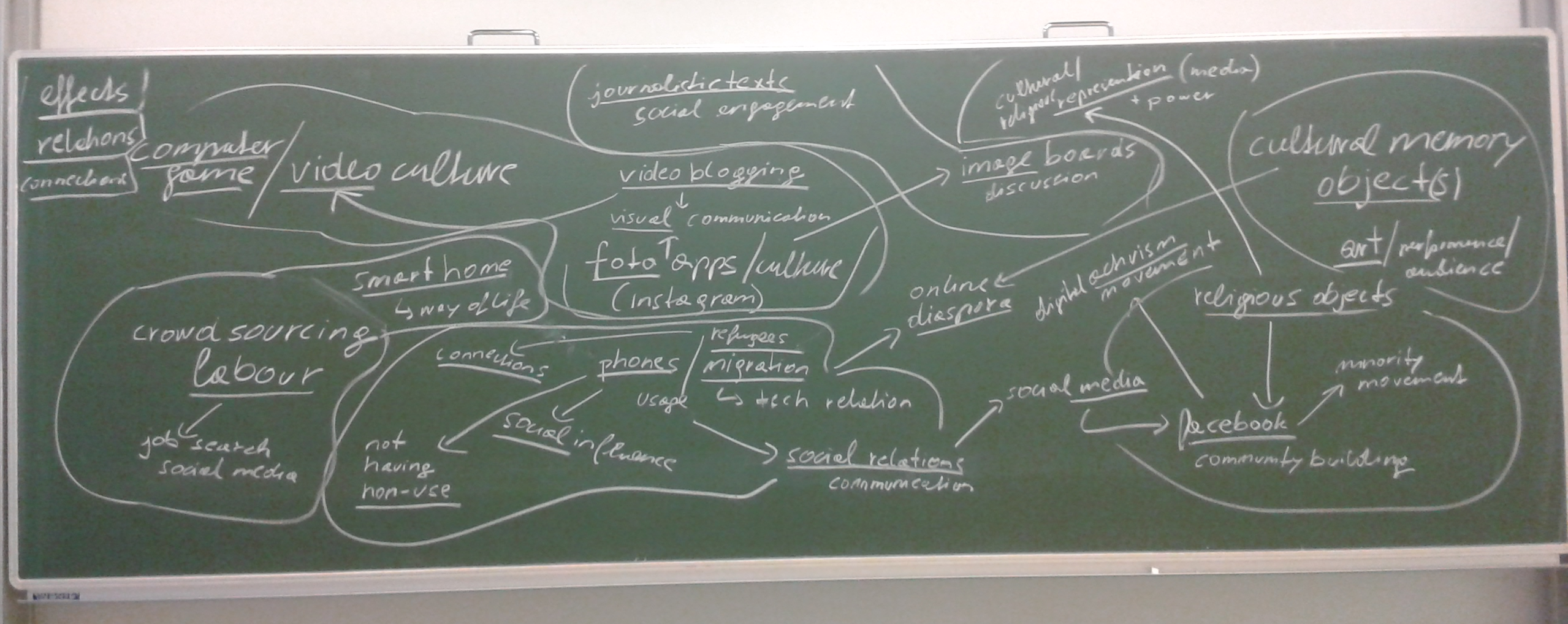
Clustering of individual ideas to create joint research projects in the seminar “Media and Visual Technologies as Material Culture” at the Department of Social and Cultural Anthropology of the University of Vienna.
Weblog of Philipp Budka

Clustering of individual ideas to create joint research projects in the seminar “Media and Visual Technologies as Material Culture” at the Department of Social and Cultural Anthropology of the University of Vienna.
Seminar “Media and visual technologies as material culture” by Philipp Budka
MA Program CREOLE & MA Program Social & Cultural Anthropology
University of Vienna
Seminar Description
This course gives an overview about material culture as conceptual approach to understand media and visual technologies. It focuses on digital media technologies, their visual aspects and how they are integrated and practiced in everyday life.
Continue reading Seminar: Media & visual technologies as material culture – course description
Budka, P. 2015. From marginalization to self-determined participation: Indigenous digital infrastructures and technology appropriation in Northwestern Ontario’s remote communities. Journal des Anthropologues – Special Issue “Margins and Digital Technologies”. No. 142-143: 127-153.
Abstract
This article discusses, from an anthropological perspective, the utilization of digital infrastructures and technologies in the geographical and sociocultural contexts of indigenous Northwestern Ontario, Canada. By introducing the case of the Keewaytinook Okimakanak Kuh-ke-nah Network (KO-KNET) it analyses first how digital infrastructures not only connect First Nations people and communities but also enable relationships between local communities and non-indigenous institutions. Second, and by drawing on KO-KNET’s homepage service MyKnet.org, it exemplifies how people appropriate digital technologies for their specific needs in a remote and isolated area. KO-KNET and its services facilitate First Nations’ self-determined participation to regional, national, and even global ICT connectivity processes, contributing thus to the “digital demarginalization” of Northwestern Ontario’s remote communities.
Budka, P. 2015. Indigenous audio-visual media production and broadcasting – Canadian Examples. Paper at “Eleventh Conference on Hunting and Gathering Societies”, Vienna, Austria: University of Vienna, September 7-11.
Introduction
This is a short position paper that sets out to briefly discuss how indigenous audio-visual media production and broadcasting initiatives haven been developed and maintained in Canada. I am concentrating on television which still is the world’s dominant audio-visual communication medium. What are the specifics of indigenous media (production) and related practices and processes? And what does the future hold for indigenous media projects? Due to limited time at hand, I am only able to open this field of research by presenting two case studies: the national Aboriginal Peoples Television Network (APTN) (e.g., Hafsteinsson 2013, Roth 2005) and Wawatay (e.g., Budka 2009, Minore & Hill 1990), a regional communication society in Northern Ontario.
Budka, P. 2015. Indigene Modernität durch digitale Medientechnologien? Infrastrukturentwicklung, Technologieaneignung und soziokulturelle Praktiken im Nordwestlichen Ontario, Kanada. Vortrag im Colloquium Americanum des Instituts für Ethnologie der Goethe-Universität Frankfurt, 25. Juni 2015. (PDF)
Inhalt:
Einleitung
„Modernität“ & Kultur- und Sozialanthropologie/Ethnologie
„Indigenisierte Modernität“
Indigene & Digitale Medientechnologien
Internetinfrastruktur im Nordwestlichen Ontario, Kanada
Soziale (sozial-digitale) Praktiken
„Indigene Modernität“ durch digitale Medientechnologien?
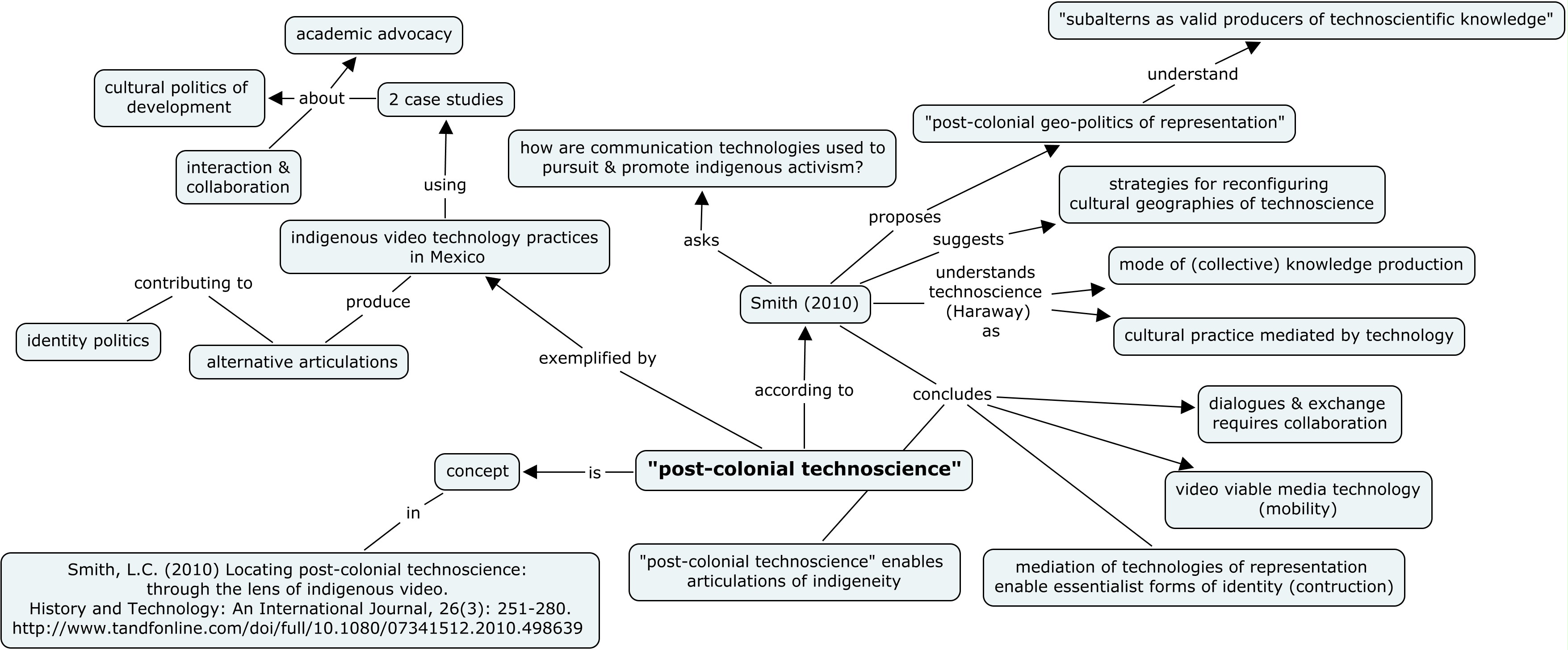
This map visualizes the concept of “post-colonial technoscience” discussed by Smith, L. C. 2010. Locating post-colonial technoscience: through the lens of indigenous video. History and Technology: An International Journal, 26(3): 251-280. It was done by using the free CMap Tools (click to enlarge).
Budka, P. 2015. Review of Unmasking deep democracy: An anthropology of indigenous media in Canada, by S. B. Hafsteinsson. Aarhus: Intervention Press, 2013. Social Anthropology, 23/2: 240-242.
In the book’s introduction Sigurjon Baldur Hafsteinsson declares that the anthropological study which resulted in Unmasking Deep Democracy will, on the one hand, challenge the anthropology of visual communication and, on the other hand, contribute to the sub-discipline’s arguments. The anthropology of visual communication, like the anthropology of media, focuses in particular on the relational aspects and characteristics of (visual) media, such as television. This volume is about indigenous television in the Canadian context. By analysing communicative and journalistic practices of the Aboriginal Peoples Television Network (APTN) it aims for gaining an insight into the sociocultural agency of indigeneity and its (media) politics.
Continue reading Review: Unmasking deep democracy: An anthropology of indigenous media in Canada
Seminar “Indigenous Media” by Philipp Budka
MA Program in Visual & Media Anthropology,
Freie Universität Berlin
Course Description
In this course students get an introduction to indigenous media technologies. In ten seminar units selected questions, issues, and problems are discussed: How do indigenous people produce, distribute, and utilize audiovisual media? How has ethnographic and anthropological film making changed? What role do politics, power, globalization, and (post-)colonialism play in the production and use of indigenous media? How do indigenous people utilize media to construct and negotiate their individual and collective identities? How are indigenous cultures and languages represented through media? And how do indigenous people appropriate and (co-)develop digital technologies in times of increasing globalization?
Budka, P. 2015. Open Access / Science & Kultur- und Sozialanthropologie. Präsentation am Institut für Kultur- und Sozialanthropologie, 14.04.2015.
Budka, P. 2015. Review of Bräuchler, B. Cyberidentities at war: The Moluccan conflict on the Internet. New York & Oxford: Berghahn, 2013. American Anthropologist, 117/1: 179-180.
Birgit Bräuchler’s book Cyberidentities at War was originally published in German in 2005. It is the result of her dissertation research on the Moluccan conflict and how it took place in cyberspace—the social space constituted by Internet-related practices. The English edition of this volume not only brings one of the few long-term ethnographic accounts of an online conflict to an international audience but also includes a new epilogue that briefly discusses what happened to the actors analyzed in the book and current developments in anthropological Internet research, particularly in respect to social movements and religions. In the early 2000s, a detailed anthropological inquiry into conflicts in relation to Internet technologies was still missing. By providing such an anthropological account and by conducting online ethnographic research, Bräuchler broke new ground and contributed to the then-emerging field of cyberanthropology.
Continue reading Review: Cyberidentities at war: The Moluccan conflict on the Internet
Workshop “Kultur- und Sozialanthropologie des Sports” bei den 10. Tage der Kultur- und Sozialanthropologie,
Institut für Kultur- und Sozialanthropologie der Universität Wien
Freitag, 24. April 2015, von 09:30 bis 13:00 im Seminarraum D
organisiert von Stefan Heissenberger (Österreichische Akademie der Wissenschaften, Humboldt-Universität zu Berlin) und Philipp Budka (Universität Wien)
In dem wegweisenden Artikel “Sport, Modernity, and the Body” betonen Nico Besnier und Susan Brownell (2012), dass eine Kultur- und Sozialanthropologie des Sports zu einem bessern Verständnis einer zunehmend globalisierten Welt beitragen kann. Hinsichtlich der ethnologischen und kultur- und sozialanthropologischen Fachgeschichte, kommt dem Phänomen Sport allerdings nur eine äußerst marginale Rolle zu. Erst ab Mitte der 1980er Jahre konnte sich im anglophonen Raum eine Anthropology of Sport als kleine Subdisziplin formieren. Nun scheint auch im deutschsprachigen Raum das Interesse an diesem Thema stetig zu wachsen. Dies drückt sich neben einem Anstieg von einschlägigen Fachpublikationen, auch in wissenschaftlichen Veranstaltungen aus, wie etwa der Konferenz Anthropology of European Football in Wien 2013 oder dem Panel Die Wahrheit liegt auf dem Platz auf der DGV-Tagung in Mainz 2013. Mit unserem Workshop wollen wir dieser
Entwicklung ein weiteres Forum bieten.
Continue reading Workshop: “Kultur- und Sozialanthropologie des Sports”
Budka, P. 2014. Review of Hess, S., Moser, J. & M. Schwertl (eds.). Europäisch-ethnologisches Forschen. Neue Methoden und Konzepte. Berlin: Reimer Verlag, 2013; 332 pp. Anthropos, 109.2014/2: 694-696.
Mit dem Sammelband „Europäisch-ethnologisches Forschen. Neue Methoden und Konzepte.“ ist es den HerausgeberInnen und AutorInnen gelungen eine wichtige, und wie ich finde längst überfällige, Sammlung rezenter Methoden und theoretischer Konzepte nicht nur für die Europäische Ethnologie/Volkskunde zusammenzustellen. Auch wenn der Titel ein Naheverhältnis des Bandes und seiner Inhalte zur Europäischen Ethnologie nahelegt, ist dieses Werk durchaus auch VertreterInnen anderer kultur- und sozialwissenschaftlichen Disziplinen – von Kultur- und/oder Sozialanthropologie bis Soziologie – empfohlen. Insgesamt 17 AutorInnen geben in 12 Beiträgen einen einführenden Überblick zu methodischen und methodologischen Überlegungen sowie Konzepten, die in den letzten Jahren im einschlägigen wissenschaftlichen Fachdiskurs massiv an Bedeutung gewonnen haben: von Ethnographie und Feldtheorien über Akteur-Netzwerk-Theorie bis hin zur Analyse visueller und materieller Kultur. Im Folgenden will ich mich einer subjektiven Auswahl an Buchbeiträgen widmen, um so zu versuchen die Bandbreite dieses Werkes und seiner Inhalte darzulegen.
Continue reading Review: Europäisch-ethnologisches Forschen. Neue Methoden und Konzepte.
Budka, P. 2014. Indigenous futures and digital infrastructures: How First Nation communities connect themselves in Northwestern Ontario. Paper at “13th Biennial Conference of the European Association of Social Anthropologists (EASA)”, Tallinn, Estonia: Tallinn University, 31 July – 3 August.
Introduction
“Now […] if the Aboriginal People could […], retain their tradition, take the technology and go that way in the future. That would be good.”
(Community Development Coordinator and Educational Director, Bearskin Lake First Nation, 2007)
For my first field trip to Northwestern Ontario in 2006, I decided to take the train from Toronto to Sioux Lookout instead of flying. This ride with “the Canadian”, which connects Toronto and Vancouver, took me about 26 hours and demonstrated very vividly the vastness of Ontario. At some point, I could not believe that I have been spending more than an entire day on a train without even leaving the province. But finally I arrived at Sioux Lookout, Northwestern Ontario’s transportation hub, where I would be working with the Keewaytinook Okimakanak Kuhkenah Network (KO-KNET), one of the world’s leading indigenous internet organization.
After my first day at the office, KO-KNET’s coordinator told me that he wants to show me something. So we jumped in his car and drove to the outskirts of the town where he stopped in front of a big satellite dish. Only through this dish, he explained, the remote First Nation communities in the North can be connected to the internet. I was pretty impressed, but had no concrete idea how this really works. So while the satellite dish was physically visible to me, the underlying infrastructure was not. During my stay, I learned more about the technical aspects of internet networks and connectivity, about hubs, switches and cables, and about towers and loops. And I learned that internet via satellite might look impressive, but is actually the last resort and the most expensive way to establish internet connectivity. I also began to realize how important organizational partnerships and collaborative projects are and what important role social relationships across institutional boundaries play. In short: I learned about the infrastructure which is actually necessary to finance, provide and maintain internet access and use. Infrastructure, KO-KNET’s coordinator told me “really defines what you can do and what you can’t do” (KO-KNET coordinator 2007). And this has fundamental consequences for the futures of the region’s indigenous people.
Within this paper I am going to discuss digital infrastructures and technologies in the geographical and sociocultural contexts of indigenous Northwestern Ontario. By introducing the case of KO-KNET I analyse (1) how internet infrastructures act as facilitators of social relationships and (2) how First Nations people actively make their (digital) futures by taking control over the creation, distribution and uses of information and communication technologies (ICT), such as broadband internet. This study is part of a digital media anthropology project that was conducted for five years, including ethnographic fieldwork in Northwestern Ontario and in online environments.
In media and visual anthropology, anthropologists are, among other things of course, interested in how indigenous, disfranchised and marginalized people have started to talk back to structures of power that neglect their political, cultural and economic needs and interests by producing and distributing their own media technologies (e.g., Ginsburg 1991, 2002b, Michaels 1994, Prins 2002, Turner 1992, 2002). To “underscore the sense of both political agency and cultural intervention that people bring to these efforts”, Faye Ginsburg (2002a: 8, 1997) refers to these media practices as “cultural activism”. “Indigenized” media technologies are providing indigenous people with possibilities to make their voices heard, to network and connect, to distribute information, to revitalize culture and language, and to become politically engaged and active (Ginsburg 2002a, 2002b). Particularly digital media technologies offer a lot of these possibilities to marginalized people (e.g., Landzelius 2006a).
Molyneaux, H., O’Donnell, S., Kakekaspan, C., Walmark, B., Budka, P., Gibson, K. 2014. Social media in remote First Nation communities. Canadian Journal of Communication, 39(2): 275-288.
Abstract
Community resilience in First Nations includes ties to people both inside and outside the community, intergenerational communication, the sharing of stories, and family and community connectedness. This study, based on a survey of Internet users in the Sioux Lookout region of Northwestern Ontario, explores the link between social networking sites and community resilience. The region is home to some of the most isolated First Nation (indigenous)communities in Canada. Cultural and familial links between these communities are strong, yet until recent use of the Internet, maintaining regular communications to strengthen cultural ties was challenging. This study examines the links between travel and communication online, the ways in which social media are used to preserve culture and maintain communication, and the implications of social networking for community resilience.
La résilience communautaire chez les Premières Nations se base sur les rapports à autrui tant au sein de la communauté qu’au-delà de celle-ci, la communication intergénérationnelle, le partage d’histoires et la solidarité familiale et communautaire. Cet article se fonde sur un sondage d’utilisateurs d’Internet dans la région Sioux Lookout du Nord-ouest de l’Ontario pour explorer les rapports entre les sites de réseautage social et la résilience communautaire. La région Sioux Lookout compte certaines des communautés autochtones les plus isolées au Canada. Les affinités culturelles et familiales entre ces communautés sont fortes, et pourtant, avant l’utilisation récente d’Internet, le maintien de communications régulières pour resserrer les liens culturels n’était pas facile. Cette étude examine les rapports entre voyages et communication en ligne, les manières dont on utilise les médias sociaux pour préserver la culture et assurer les communications, et l’impact du réseautage social sur la résilience communautaire.
The Society for Cultural Anthropology, in March 2013, announced plans for Cultural Anthropology to become an open access journal. Starting with its February 2014 issue (volume 29, number 1), new issues of the journal became freely available online through the CA website, and plans are in the works to make back issues available as well.
more info at: http://www.culanth.org/articles/open_access
first open access issue: http://www.culanth.org/issues/162-29-1-february-2014